



By Mr Ali Abbasian FRCS (Tr & Orth), Consultant Orthopaedic Foot and Ankle Surgeon, London
Last reviewed: October 2026
An ankle replacement can give many years of pain relief while keeping the ankle moving. Some replacements, though, loosen, wear out or become painful. This guide explains why ankle replacements fail, how they are assessed, and the options for treatment: a new (revision) replacement, a fusion, or a custom 3D-printed implant. It is written for patients and for the clinicians who refer them.
Key points
- In pooled data, about 1 in 8 ankle replacements need revision by 7 years and nearly 1 in 5 by 10 years.
- Younger patients are much more likely to need revision.
- Infection must be found or ruled out before any other decision is made.
- The main choice is between a new replacement and a fusion. The health of the joint below the ankle and the amount of bone left guide that choice.
- Custom 3D-printed implants can fill large bone defects where standard implants fall short.
- Revision surgery helps, but results are usually not as good as a successful first replacement.
On this page
- How often do ankle replacements fail?
- Why do ankle replacements fail?
- Who is at higher risk?
- What are the signs of a failing ankle replacement?
- How is a failing ankle replacement assessed?
- Revision or fusion: how is the choice made?
- What is revision ankle replacement?
- Custom 3D-printed implants
- What results can I expect?
- Quick comparison
- For referring clinicians
- Frequently asked questions
How often do ankle replacements fail?
As more ankle replacements are performed, more need further surgery. One recent review reports that the number of primary ankle replacements rose by 284% between 2010 and 2020, and revisions have risen with it.1
Pooled clinical and registry data put the revision rate at about 12.6% at 7 years and 18.0% at 10 years.2 Age makes a big difference. In the UK National Joint Registry, about 17% of patients under 65 needed revision within 13 years, compared with about 3% of those over 75.2
Revision is needed over time even in very experienced units. In a Swiss study of 1,006 ankle replacements, 4.8% had been revised at 5 years and 12.1% at 10 years.3
For more on how long a replacement lasts compared with a fusion, see my guide to ankle replacement vs ankle fusion.
Why do ankle replacements fail?
The most common reasons are loosening of the implant from the bone and bone loss around it (osteolysis).1 Other causes include:
- wear or breakage of the plastic liner
- the implant sinking into the bone (subsidence)
- infection
- instability
- pain with no clear cause
In the Swiss study, instability (34%) was a more common reason for revision than loosening (28%).3
Who is at higher risk?
Patient factors
Younger age, obesity, diabetes, smoking and deformity before surgery all raise the risk of failure.1
Alignment
In the Swiss study, major deformity of the heel and foot before surgery was linked to about 2.5 times the risk of revision, and an outward-tilted (valgus) ankle carried more risk than an inward-tilted (varus) one.3 These figures come from a single study. Deformities of up to about 20° can still do well if the ankle ends up straight after surgery.1
Previous surgery
A previous fusion of the hindfoot on the same side has been linked to a higher chance of early mechanical failure.1
Implant design
Implants with a stem or keel in the shin bone (tibia) appear less likely to fail on that side.1
What are the signs of a failing ankle replacement?
See your surgeon if you notice:
- new or worsening pain after a period of comfort
- swelling that does not settle
- the ankle giving way or feeling unstable
- a change in the shape or position of the ankle
- redness, heat, a wound that will not heal, or fever, which can mean infection and need urgent review
How is a failing ankle replacement assessed?
A painful ankle replacement needs a careful, step-by-step assessment. A 2026 decision-making framework focuses on four questions:4
- Are the implant and the hindfoot correctly aligned?
- Is there infection around the implant? This must be found or ruled out early.
- How much bone is left?
- Is the implant stable?
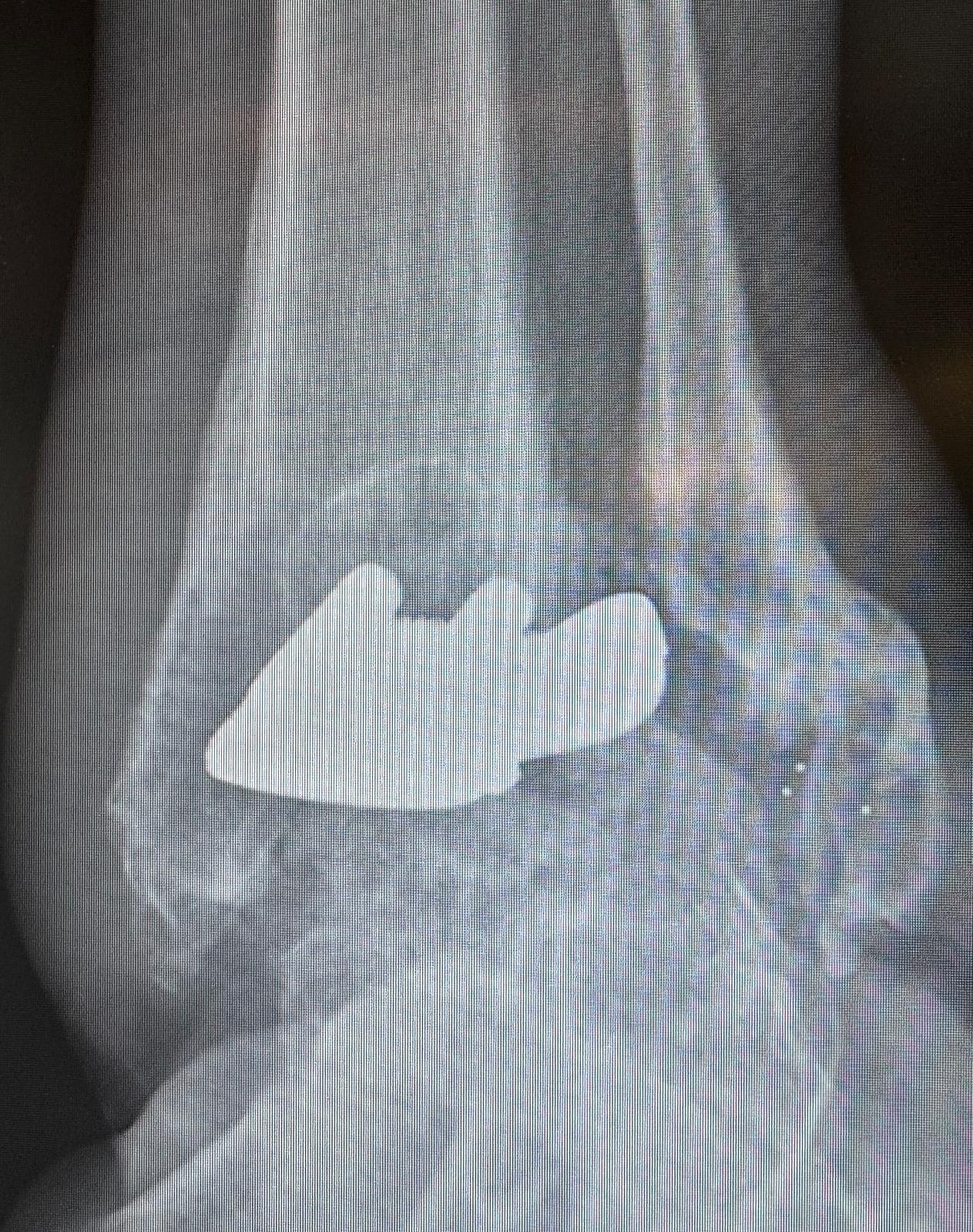
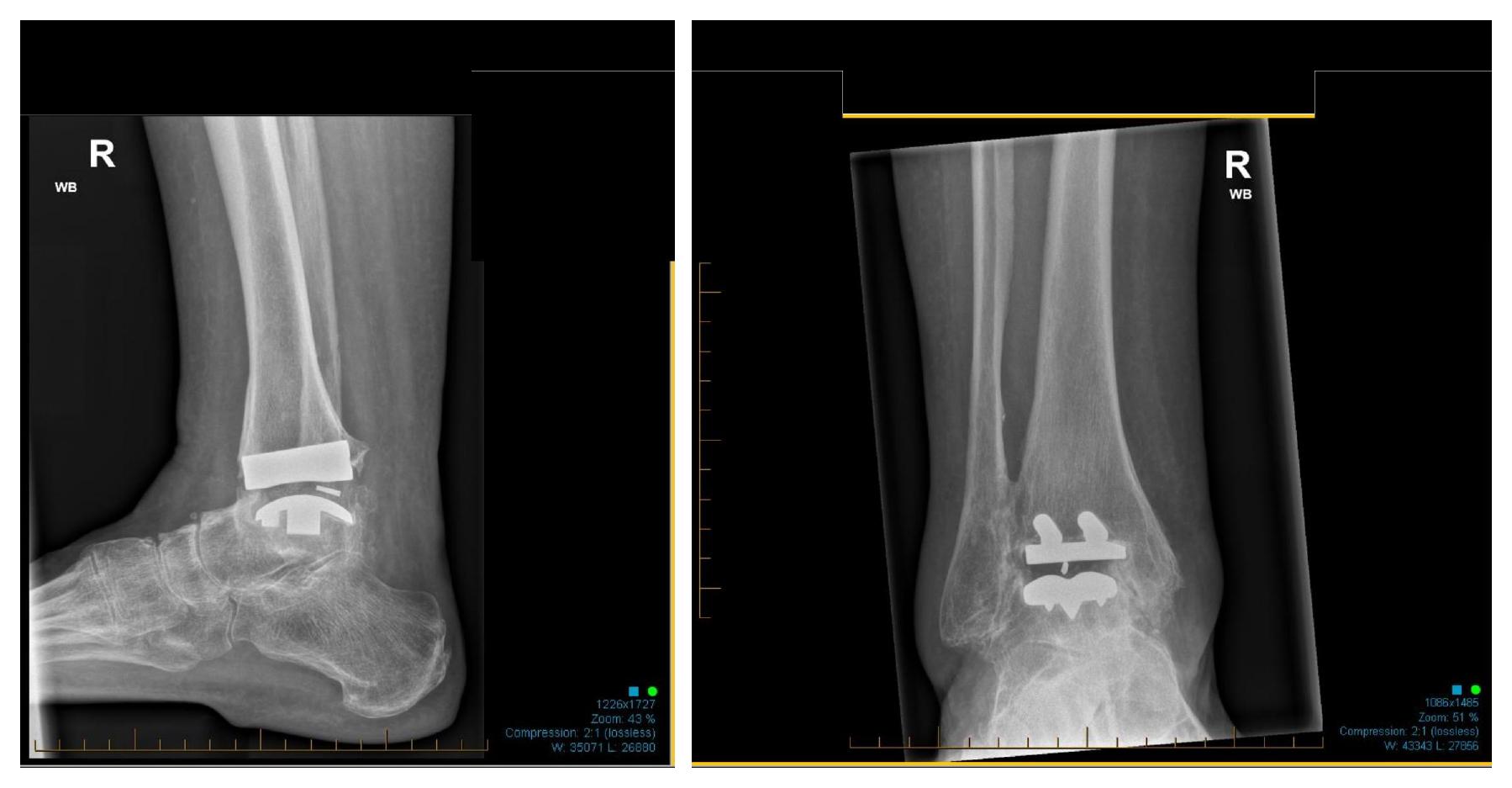
A weight-bearing CT scan, taken while you stand, has become central to this. It shows how much bone has been lost and is used to design custom implants.1 Blood tests, and sometimes a sample of fluid from the joint, help check for infection.
Revision or fusion: how is the choice made?
Once infection has been dealt with, there are two main options:
- Revision ankle replacement: the failed parts are removed and a new replacement is put in.
- Fusion: the implant is removed and the bones are joined. This is usually a tibiotalocalcaneal (TTC) fusion, which fuses both the ankle and the joint below it (the subtalar joint), often held with a nail through the heel.
A revision replacement works best when there is good bone, the neighbouring joints are healthy and the skin and soft tissues are in good condition.1
A study comparing the options found each has trade-offs:5
- TTC fusion gave the most reliable pain relief.
- Revision replacement gave better walking, including on uneven ground, with less wear in the neighbouring joints.
- Fusion of the ankle joint alone failed 4.35 times more often than revision replacement. This applies to ankle-only fusion, not TTC fusion.
A practical rule follows from this: revise the replacement if the subtalar joint is healthy, and choose TTC fusion if it is arthritic.5 If the lower part of the implant has sunk down to the level of the subtalar joint, fusion is usually the better option.6
There is no clear agreement that one approach is better overall. Patients with the worst bone loss tend to be fused, which makes direct comparison difficult.6,7
What is revision ankle replacement?
Revision implants are designed to fill bone defects and gain a firmer hold higher up in the shin bone, often with a longer stem. Early and mid-term results are encouraging:1
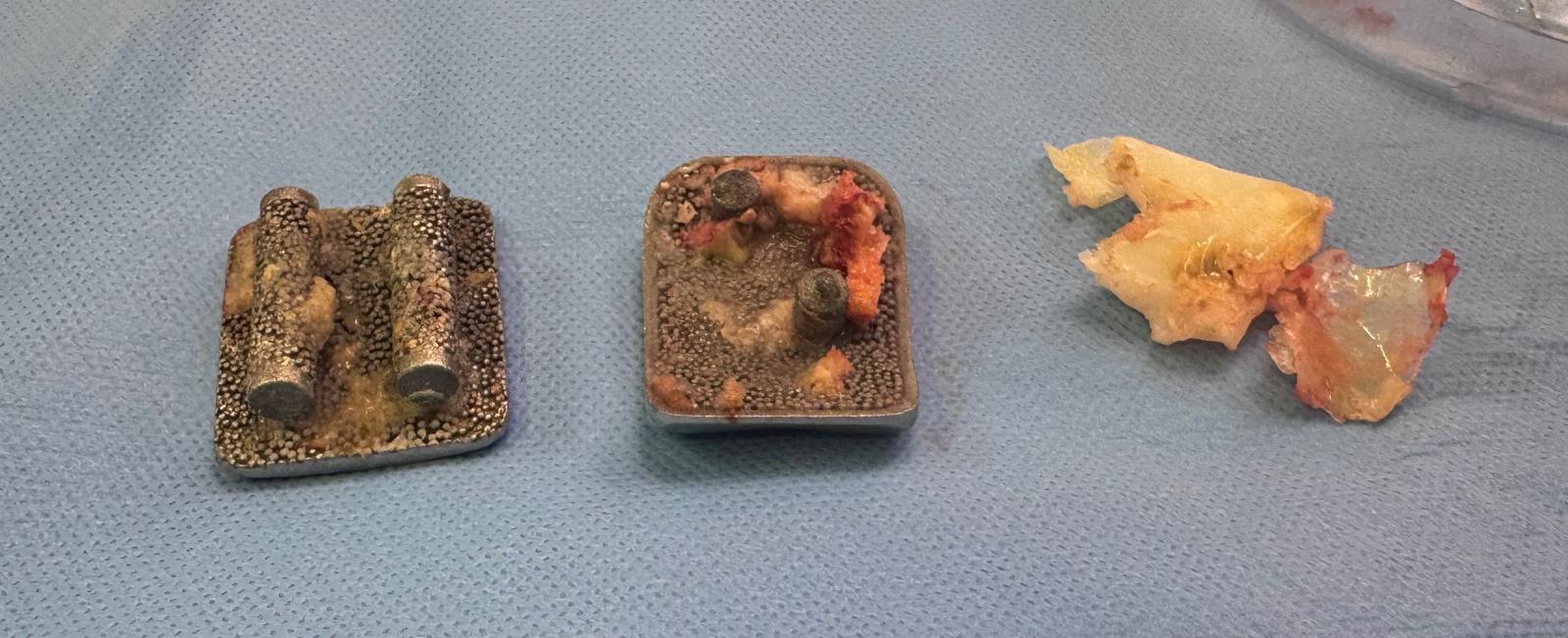
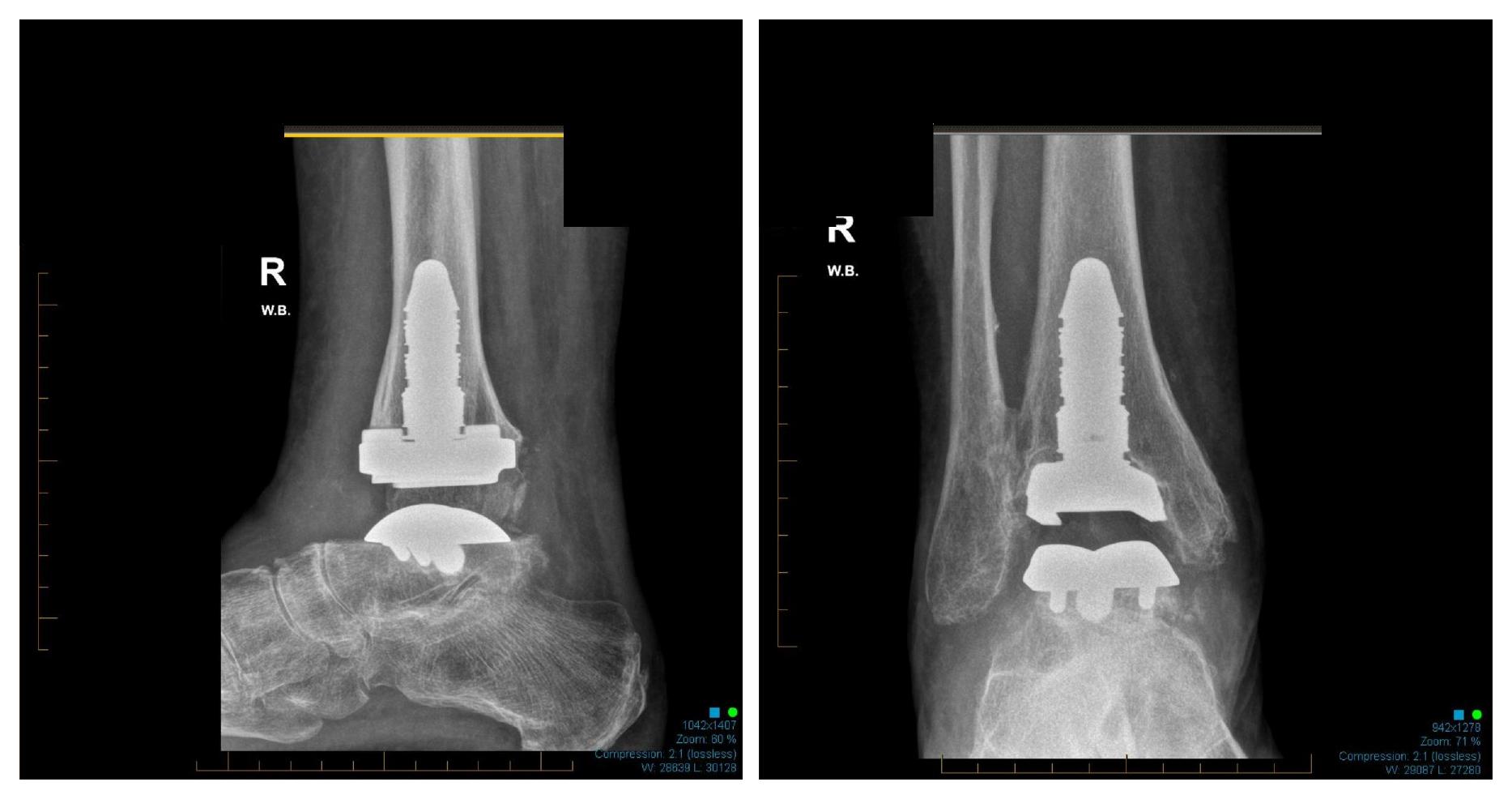
- In a UK series of 29 revisions using one stemmed implant (INBONE II), 97% were still in place at an average of 40 months. Infection and further surgery each occurred in 7%.8
- A Swiss group followed 117 revisions for an average of 15 years. 81% of implants were still in place at 5 years, 74% at 10 years and 70% at 15 years.9
These are complex operations. Reviews report complication rates of up to 37% and further surgery in up to 41%. When the lower (talar) part of the implant fails, about 1 in 4 patients need another revision.7
Custom 3D-printed implants
Patient-specific implants are one of the biggest recent advances in treating a failed ankle replacement. They are designed from your CT scan to fit your bone exactly.
Custom titanium cages for fusion
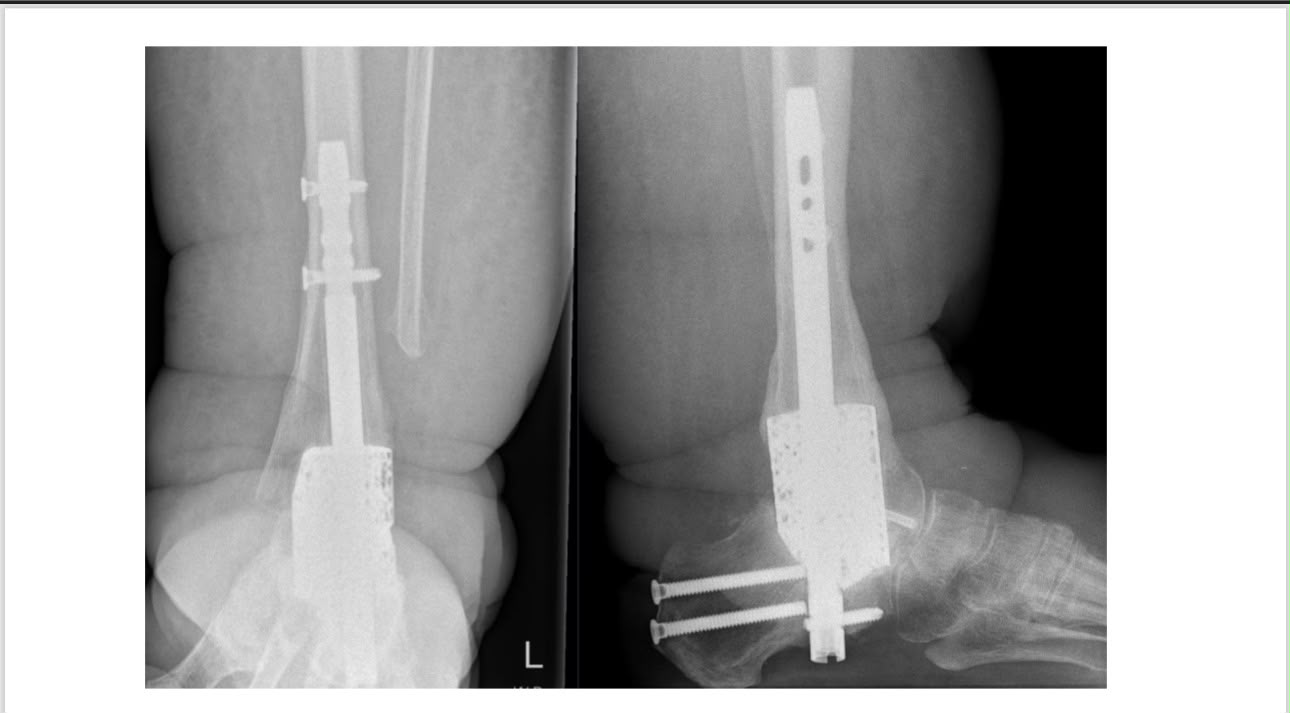
When a lot of bone has been lost, a 3D-printed titanium “truss” cage can fill the gap. It is usually combined with a nail through the heel and packed with bone graft.
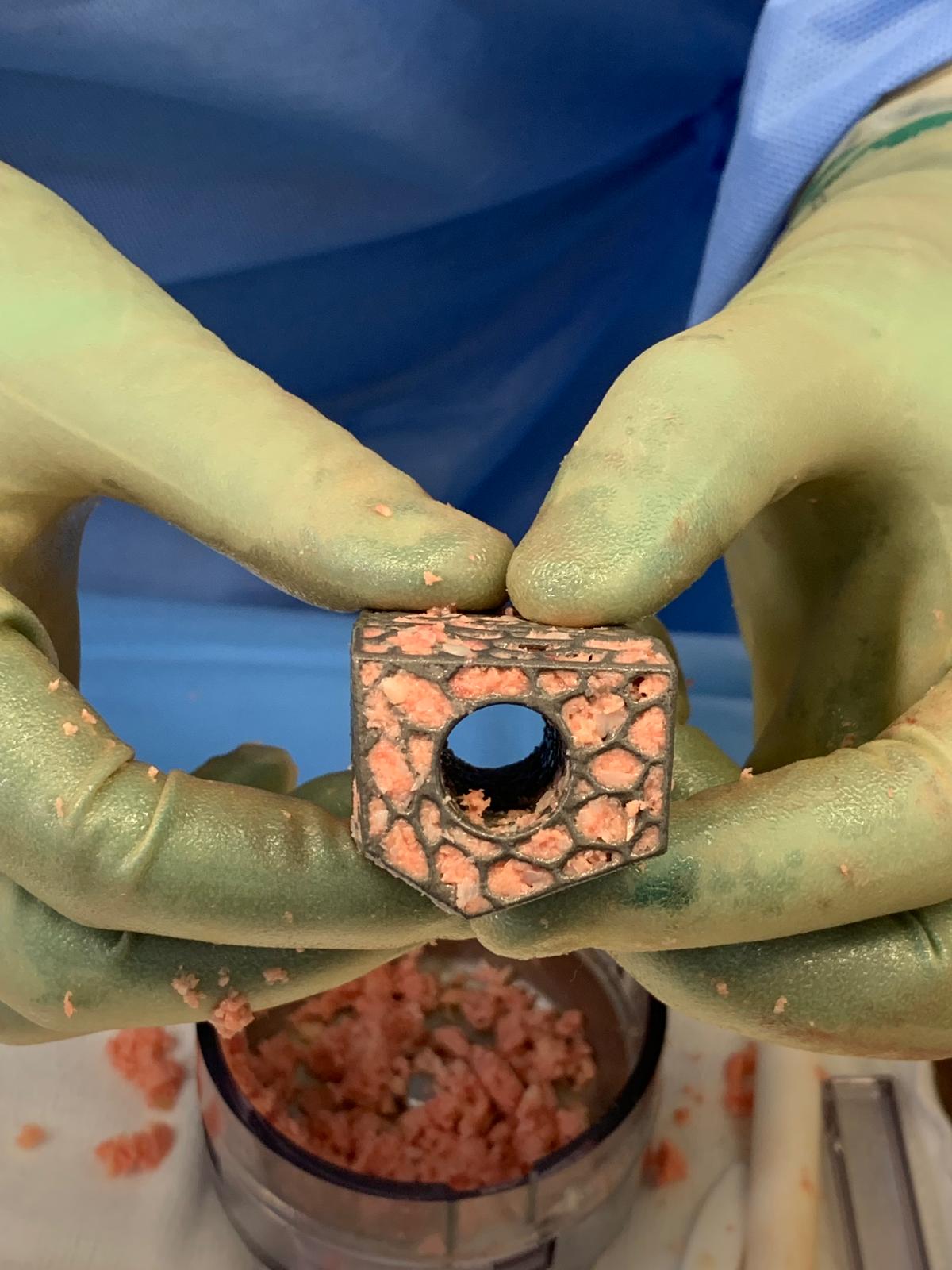
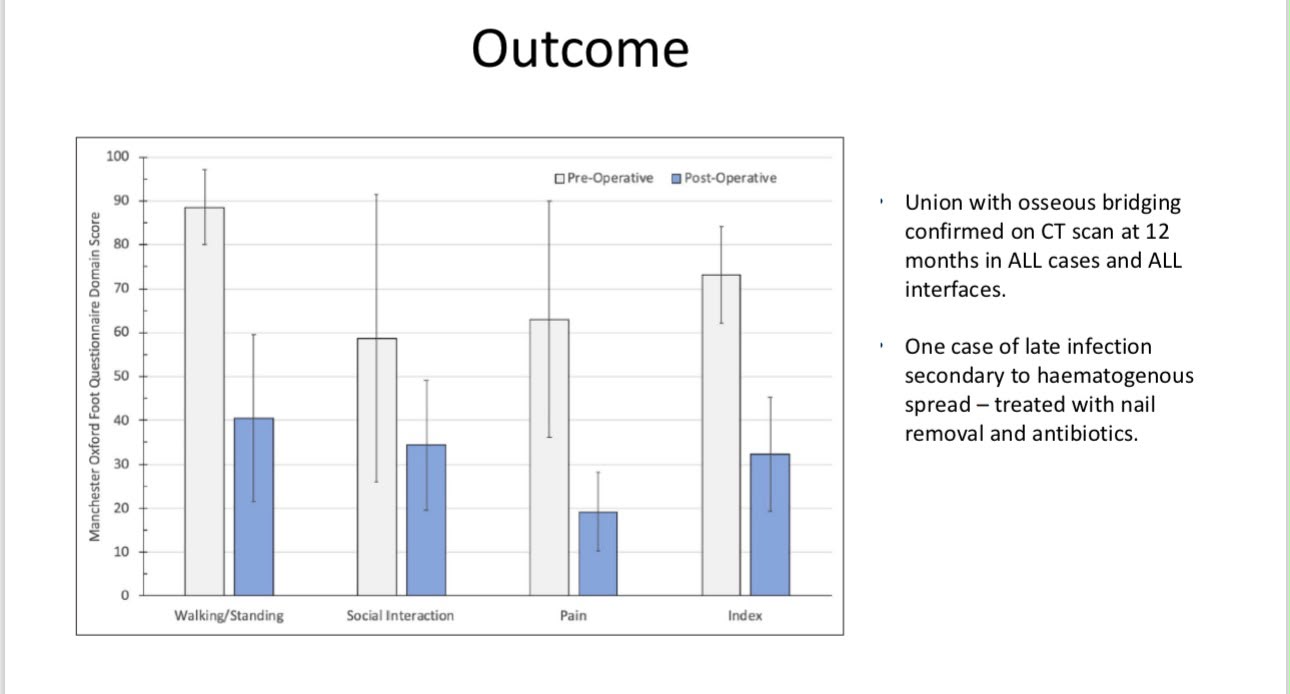
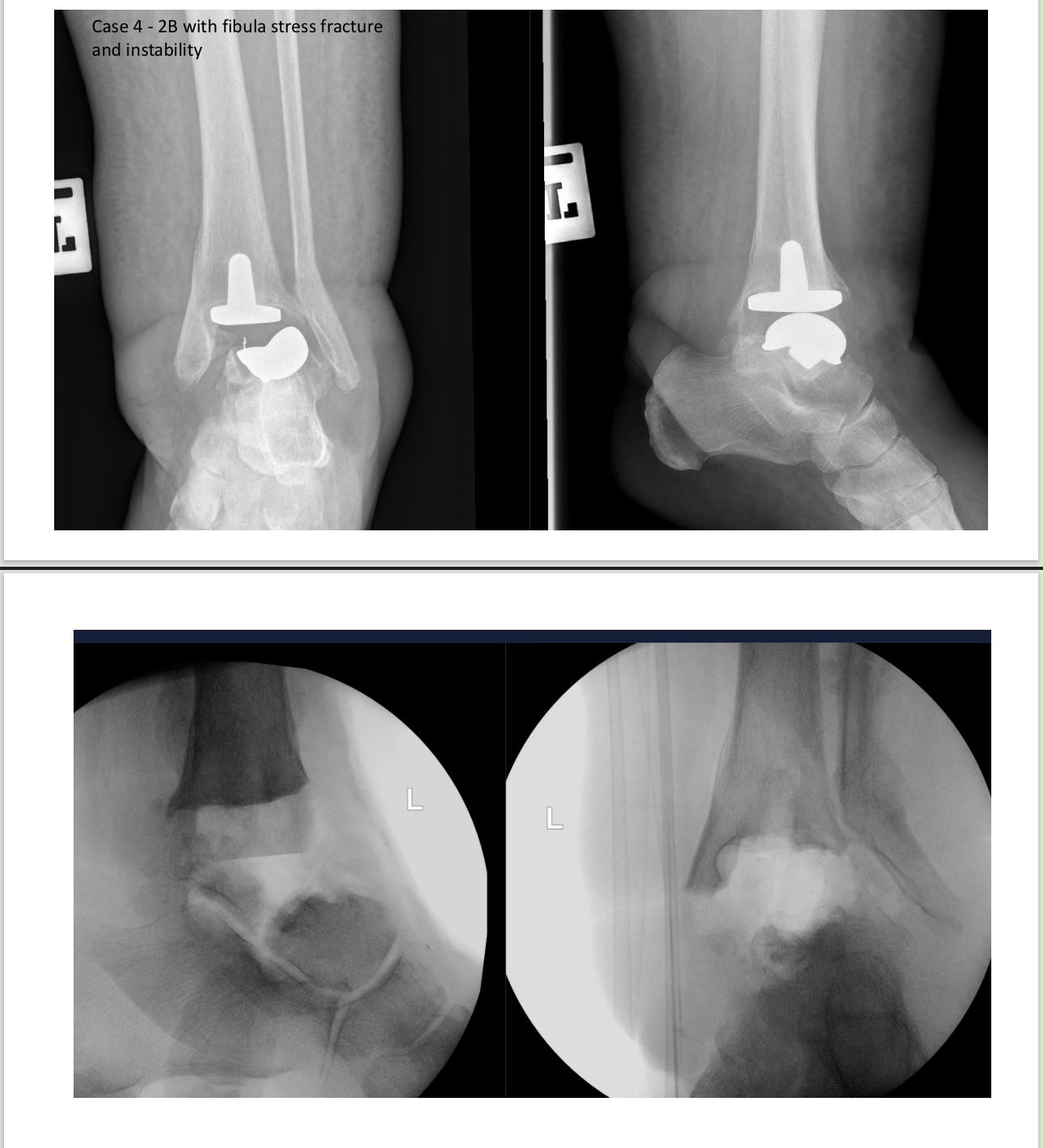
My team at Guy’s and St Thomas’ has published a classification, technical tips and a treatment algorithm for using these custom implants after failed ankle replacement.10 Known as the Guy’s Hospital classification, it describes the pattern of bone loss after a failed ankle replacement and guides the shape of each custom implant.
Reported fusion rates with custom titanium cages are 87–100%, compared with about 76–87% for conventional fusion after a failed replacement.10 Historically, the bones failed to join in 11% to 42% of conventional fusions in this setting. Custom implants have shown higher fusion rates and less loss of graft than a large donor bone graft.6
Custom talus with ankle replacement
If the talus (the bone below the ankle joint) has collapsed or lost its blood supply, a 3D-printed talus can be combined with a new shin-bone component. Early results are encouraging, but follow-up is short.1
What results can I expect?
Revision surgery helps, but it usually does not match a successful first replacement. Patient-reported results improve significantly after revision but stay below those after a first replacement.9,11
Recovery takes at least twice as long as after a first replacement.6 Below-knee amputation remains a last resort.6
Most evidence still comes from small single-centre studies, often led by implant designers, and follow-up for custom implants is short. Registry data give a more realistic picture of everyday practice.7
Revision replacement vs fusion: quick comparison
| Revision ankle replacement | TTC fusion | |
|---|---|---|
| Ankle movement | Kept | Lost |
| Subtalar joint | Healthy | Arthritic |
| Bone stock | Good | Any, including major loss |
| Pain relief | Good | Most reliable |
| Uneven ground | Easier | Harder |
| Large bone defects | Stemmed or custom implants | Custom titanium cage |
| Main concerns | Further revision | Bones failing to join |
For referring clinicians
Key points for assessment and referral:
- Rule out periprosthetic joint infection first.
- Weight-bearing CT defines bone loss and is required for custom implant planning.1
- Assess alignment, bone stock, implant stability and the subtalar joint.4
- Revision TAR suits good bone stock, a healthy subtalar joint and adequate soft tissues. TTC fusion is favoured with subtalar arthritis or talar subsidence to the subtalar level.5,6
- Cortical rim support matters more than stem fixation. Impaction grafting and blocking screws help position the stem.7
- Australian registry data show a 16.8% re-revision rate at 10 years.7
I accept referrals for failing and painful ankle replacements through the NHS at Guy’s and St Thomas’ and privately in London. Contact details.
Frequently asked questions
Can a failed ankle replacement be replaced again?
Often, yes. A revision replacement works best when there is good bone, no infection and the joint below the ankle is healthy.
How do I know if my ankle replacement is failing?
New or worsening pain, swelling or instability are the usual signs. X-rays, a CT scan and tests for infection confirm the cause.
Is revision or fusion better after a failed ankle replacement?
Neither is better for everyone. Fusion gives the most reliable pain relief; revision keeps movement and makes walking on uneven ground easier.
How long is recovery after revision surgery?
Expect recovery to take at least twice as long as after a first ankle replacement.
What is a custom 3D-printed ankle implant?
An implant designed from your CT scan to fill your bone defect exactly. It is used when standard implants cannot restore enough support.
Can I still have surgery if a lot of bone has been lost?
Usually, yes. Custom titanium cages and revision implants are designed for large bone defects.
Is revision surgery available on the NHS?
Yes. Revision ankle surgery is available on the NHS and privately, usually in specialist foot and ankle units.
Book a consultation
Mr Ali Abbasian is a Consultant Orthopaedic Foot and Ankle Surgeon at Guy’s and St Thomas’ Hospital and in private practice in London. He treats failed and painful ankle replacements, including revision surgery, fusion and custom 3D-printed reconstruction.
You may also find my ankle replacement FAQ guide useful.
This article is for general information and does not replace a personal assessment by a foot and ankle surgeon.
References
- Pedowitz DI et al. Revision total ankle arthroplasty: a contemporary review. Foot & Ankle International, 2026. doi:10.1177/10711007261472454
- Lee C et al. Management of the failing ankle arthroplasty: an algorithm to assist decision-making. Bone & Joint Journal, 2026. doi:10.1302/0301-620X.108B3.BJJ-2025-0547.R1
- Richter D et al. What are the indications for implant revision in three-component total ankle arthroplasty? Clinical Orthopaedics and Related Research, 2021. doi:10.1097/CORR.0000000000001517
- Lee C et al. Bone & Joint Journal, 2026 (as reference 2).
- Pfahl K et al. Outcomes of salvage procedures for failed total ankle arthroplasty. Foot & Ankle International, 2023. doi:10.1177/10711007231156426
- Henry JK et al. Evaluating and managing the painful total ankle replacement. Foot & Ankle International, 2021. doi:10.1177/10711007211027273
- Henry JK, Karas E, Demetracopoulos CA. Techniques and strategies for managing complex failures in total ankle arthroplasty. Foot & Ankle International, 2026. doi:10.1177/10711007261471832
- Jamjoom BA et al. Clinical and radiographic outcomes of revision total ankle arthroplasty using the INBONE II prosthesis. Journal of Bone and Joint Surgery, 2022. doi:10.2106/JBJS.21.01240
- Hintermann B et al. Survival and risk assessment in revision arthroplasty of the ankle. Bone & Joint Journal, 2024. doi:10.1302/0301-620X.106B1.BJJ-2023-0716.R2
- Lewis TL, Walker R, Alkhalfan Y, Latif A, Abbasian A. Custom patient-specific 3D-printed titanium truss tibiotalocalcaneal arthrodesis implants for failed total ankle replacements: classification, technical tips, and treatment algorithm. Foot & Ankle International, 2024. doi:10.1177/10711007241255381
- Jennison T et al. A prospective cohort study comparing functional outcomes of primary and revision ankle replacements. Foot & Ankle International, 2021. doi:10.1177/10711007211010188


