





© Ali Abbasian
Website Designed ByKeyhole bunion surgery, also called minimally invasive or percutaneous bunion surgery, corrects a bunion through a few very small cuts rather than one long incision. I perform keyhole bunion surgery in London, at Guy’s and St Thomas’ and in private practice at HCA hospitals, using a modern fourth-generation technique. You can walk on your foot straight away in a special shoe, with good or excellent results in over 90% of patients.
On this page
A bunion (hallux valgus) is a bony lump at the base of the big toe. It forms when the first metatarsal bone drifts outwards and the big toe leans towards the smaller toes. Bunions often run in families and can be made worse by tight or narrow shoes.
Common symptoms include:
Surgery is not the only option. Wider, softer shoes, padding over the bump and insoles can ease symptoms. These do not straighten the toe, but many people are comfortable enough not to need an operation.
Surgery is worth considering if your bunion is painful despite sensible footwear, or is affecting your daily life. I do not recommend surgery for appearance alone.
This is a day-case procedure under general anaesthetic, with a local anaesthetic block to numb the foot for some hours afterwards. Using X-ray guidance, I make a few cuts in the skin, each only a few millimetres long. Through these, I cut and realign the first metatarsal bone with a small burr, then hold it in its new position with two screws. I also make a small cut in the bone of the big toe (an Akin osteotomy) to straighten it fully, held with a third screw.
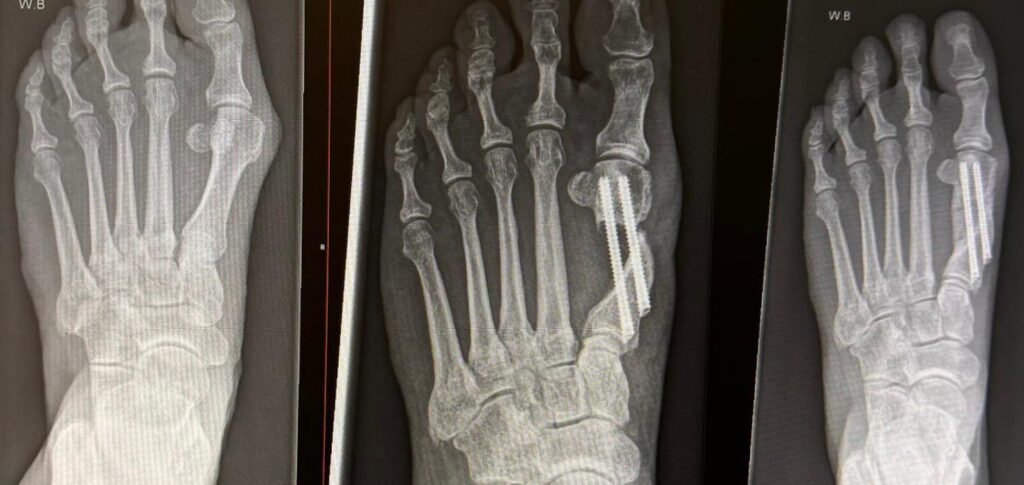
Progressive remodelling over six months showing how bone is laid down.
The aim is the same as traditional open surgery: to straighten the big toe and remove the bump. The difference is the smaller cuts and less disturbance to the soft tissues.
Keyhole surgery is suitable for most bunions. Very severe bunions, or those with arthritis in the big toe joint, may be better treated with open surgery or a different operation. I will discuss which is right for you.
Results at five years are similar to traditional open surgery. The possible benefits of the keyhole approach are smaller scars, less pain in the early weeks and fewer wound problems, though studies have not consistently shown it is better overall. There is less long-term information beyond five years, and with any bunion operation the correction can lessen slightly over time.
Around 9 out of 10 people have a good or excellent result and are satisfied with their surgery. The bunion coming back is uncommon, affecting about 1 to 5 in 100 people in modern studies.
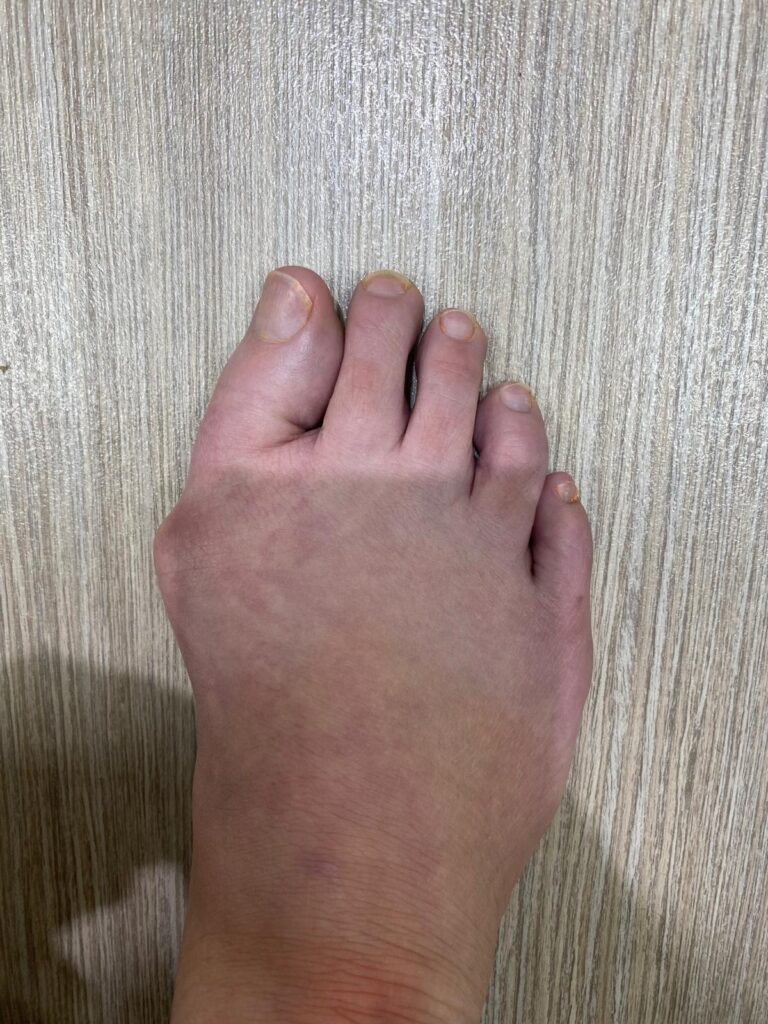 Before
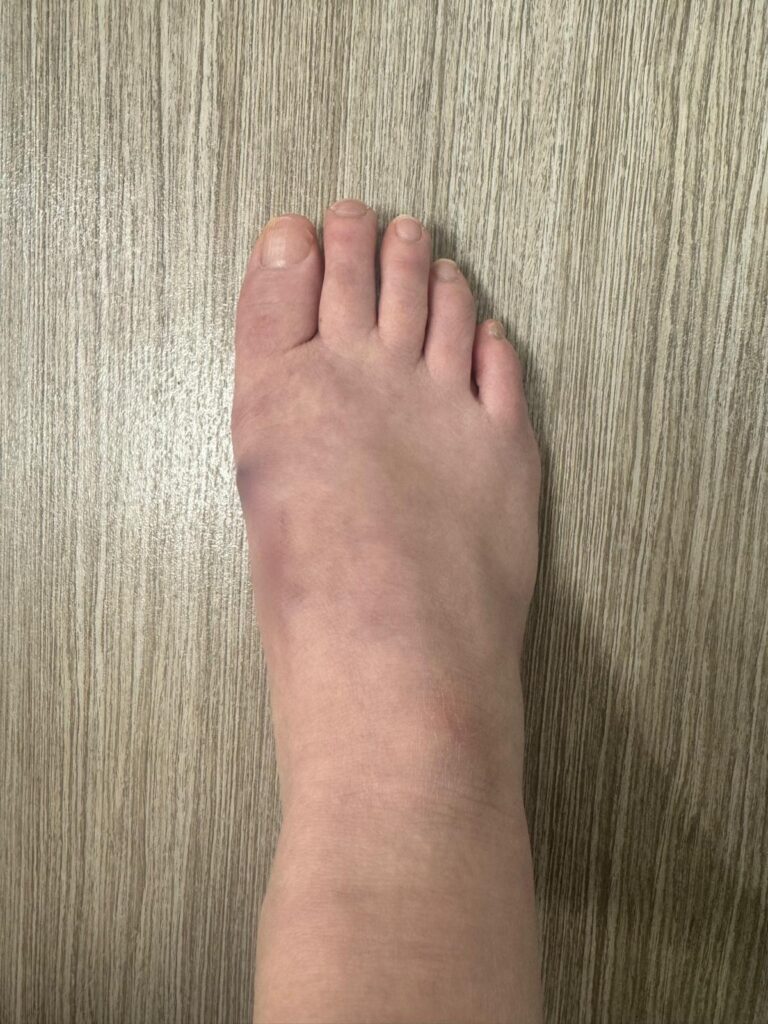 After
Complications affect roughly 1 in 10 to 1 in 4 people, depending on how they are counted. Most are minor. These risks should be read alongside the general risks of foot and ankle surgery and anaesthesia.
You can walk on your foot straight away in a protective post-operative shoe. The local anaesthetic block usually wears off within a day, so start your pain relief before it does. Keep your foot raised as much as possible to control swelling and pain, and keep the dressing clean and dry. I will see you at around two weeks to check the wounds.
You will keep wearing the post-operative shoe and can gradually do more. Swelling is normal and will be worse at the end of the day. An X-ray at around six weeks checks that the bone is healing.
Most people move into wide, comfortable trainers between four and six weeks. Swelling settles gradually over several months, so you may not get into narrower or smarter shoes for a while. Low-impact exercise can start once you are in trainers, building up to running and sport over the following weeks, guided by how your foot feels.
Many people have less pain in the first few weeks than after open surgery, but you should still expect some discomfort and swelling.
If you have a desk job and can keep your foot raised, you may be able to return after about two weeks, or sooner if you work from home. Jobs that involve a lot of standing or walking will take longer, and we can discuss this based on your job.
Most people can drive again between four and six weeks, once they are out of the post-operative shoe and can stop safely in an emergency. If the surgery is on your left foot and you drive an automatic, you may be able to drive as soon as you feel able. Check with your insurer before driving.
This is uncommon after modern keyhole surgery, affecting about 1 to 5 in 100 people.
If your bunion is painful or making it hard to find shoes that fit, I can assess whether keyhole surgery is the right option for you. I see patients privately at HCA hospitals in London. Request an appointment or message us on WhatsApp.