





© Ali Abbasian
Website Designed ByShockwave therapy (extracorporeal shockwave therapy, or ESWT) is a non-surgical treatment for long-standing heel and tendon pain. I deliver shockwave therapy myself in London, at The Wellington Hospital and 30 Devonshire Street, after assessing the problem with ultrasound in clinic. It works best for chronic plantar fasciitis. For Achilles tendon pain, the evidence is weaker, and I will explain honestly whether it is likely to help you.
On this page
Shockwave therapy uses pressure waves, passed through the skin, to treat the painful area. It is thought to work by stimulating the body’s own repair processes, including new blood vessel growth and collagen production, and by reducing pain signals from the area.
It is usually offered for problems that have lasted several months and have not improved with standard treatment such as stretching, strengthening exercises, footwear changes and insoles.
This is where the evidence for shockwave therapy is strongest. In a large trial, heel pain fell by around two-thirds after shockwave treatment, compared with around one-third after a dummy treatment. Overall, about half to two-thirds of people have a successful result. Compared with a steroid injection, shockwave gives better pain relief at three and six months.
Results are best when shockwave is combined with a stretching and strengthening programme. Read more about plantar fasciitis.
For Achilles tendinopathy, the evidence is much weaker. The most recent reviews of the research found no clear benefit over a dummy treatment, for problems either in the middle of the tendon or where it attaches to the heel. A programme of loading exercises remains the main treatment.
Shockwave can sometimes be used alongside exercises, but you should expect a modest and uncertain benefit. I will discuss whether it is worth trying in your case, or whether another treatment would suit you better. Read more about Achilles tendon problems.
I will first assess your foot, using ultrasound in clinic to confirm the diagnosis. I use radial shockwave, which spreads the pressure waves over the painful area. A course of treatment is usually three to six sessions, around a week apart. Each session delivers up to 4,000 pulses through a small handheld device, using gel on the skin.
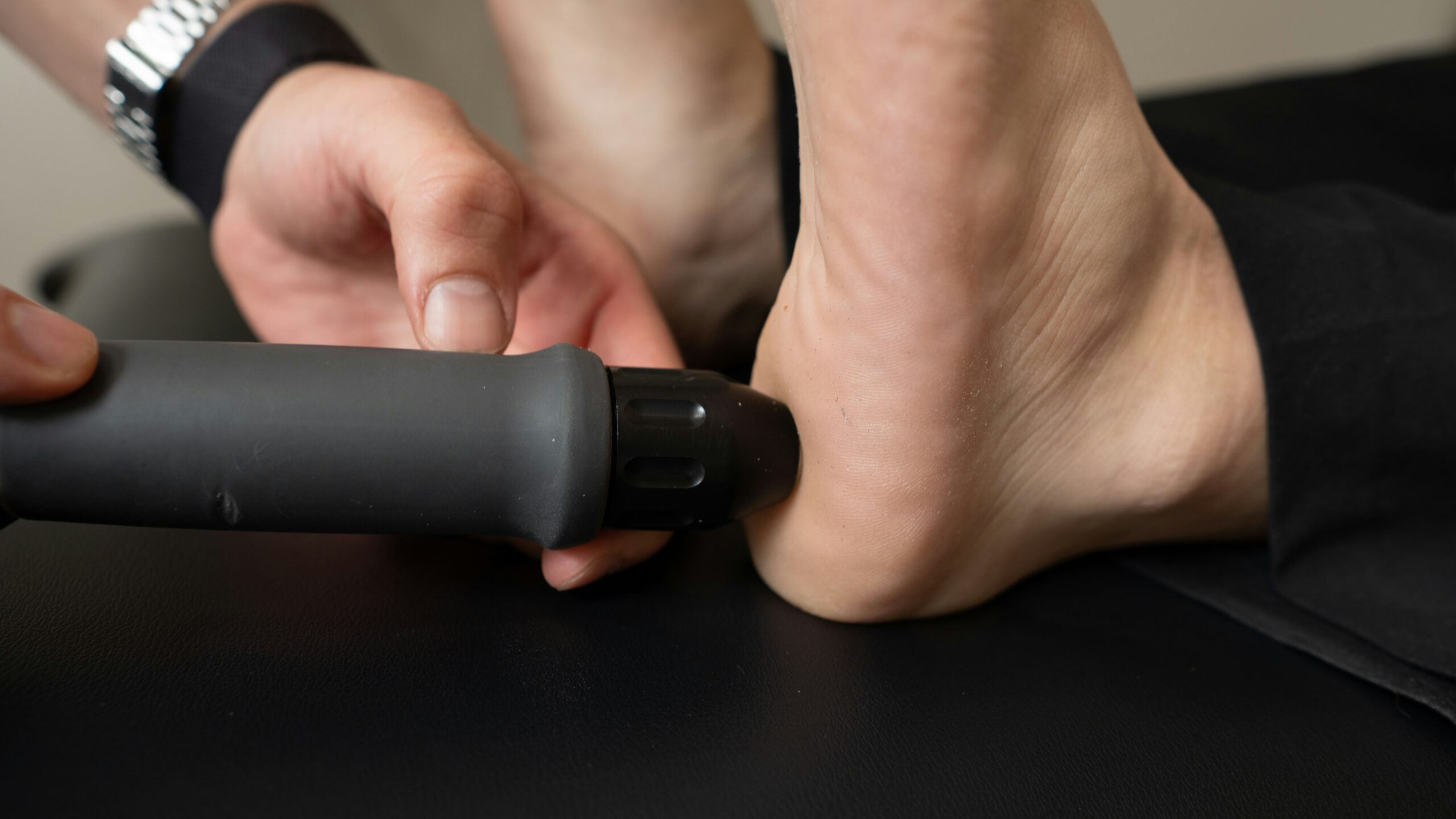
Each session can take 5 to 10 minutes, but please expect the visit to take 20 to 30 minutes.
The treatment can be uncomfortable, but you don’t usually need any anaesthetic, and you can walk normally straight afterwards.
Shockwave is not an instant fix. Improvement usually builds gradually over the weeks and months after treatment, so it is important to keep up your exercises during this time.
Shockwave therapy is low-risk. Common side effects are short-lived and include:
Rarely, people have felt faint or had a migraine. Very rarely, an Achilles tendon has ruptured after shockwave treatment, so I assess the tendon carefully beforehand, particularly in people over 60. No serious lasting damage to the tissues has been reported.
Shockwave therapy is not suitable if you:
Please tell me if you take blood thinners or have a bleeding disorder, have had a steroid injection in the area recently, or have other significant health problems. Shockwave may still be possible, but it needs careful assessment.
Other options include continuing physiotherapy, injections, and, for the small number of people whose pain doesn’t settle, surgery. I will talk through what makes most sense for you.
Cover varies between insurers. Some cover shockwave therapy when it is given by a consultant, while others only cover it when it is given by a physiotherapist. Please check with your insurer before starting treatment. If you are paying for yourself, we can give you the cost of a course of treatment in advance.
If you have heel or tendon pain that hasn’t improved with standard treatment, I can assess whether shockwave therapy or another treatment is right for you. Request an appointment or message us on WhatsApp.